Railroad Policy – 1: Train Air Brake Policy
A. Written Procedures:
If the in-plant railroad uses a train’s air brake system to control and stop train movements, the company shall develop written procedures regarding the use, testing and inspection of the train air brake systems on its railroad equipment. The procedures shall be tailored to the company’s in-plant railroad environment where employees are required to work.
B. Training and Qualification of Employees:
- Work as a member of a train crew that uses the train’s air, including locomotive engineers or motive equipment operators, conductors and/or ground persons
- Perform train air brake tests
- Inspect train air brake systems and/or components
- Change brake shoes
- Perform mechanical repairs to train air brake systems and/or components
C. Train Air Brake Procedures
The company’s train air brake procedures shall, at a minimum, address the following topics:
- Identification of the name, function, operation, inspection requirements, potential hazards and safety measures associated with air brake system components, including, but not limited to the following:
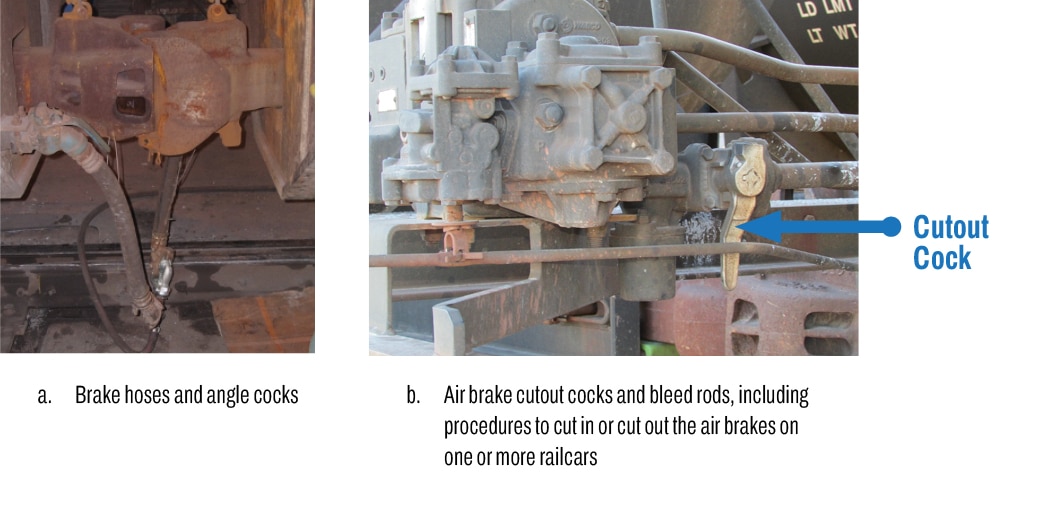
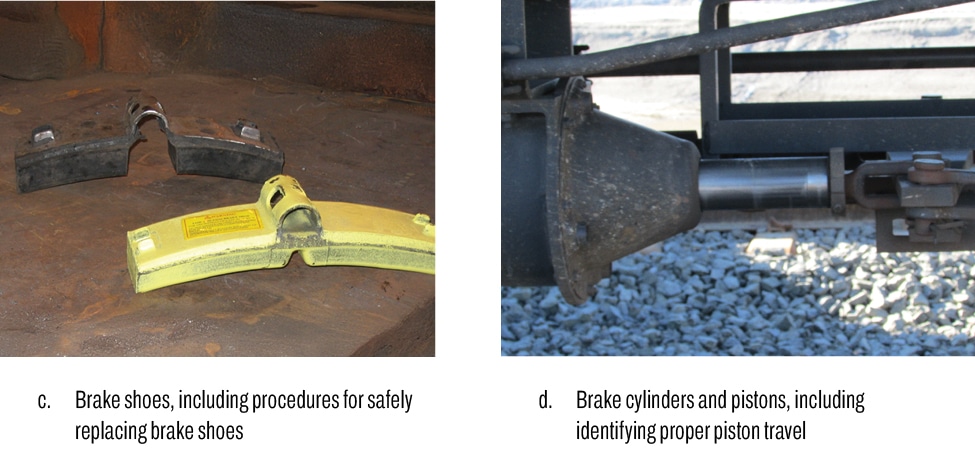
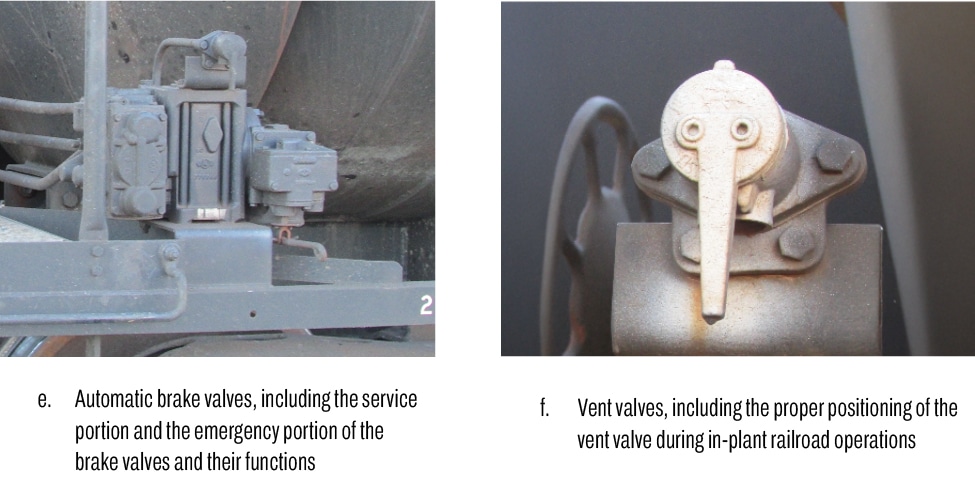
- Brake rigging, including procedures for performing visual inspections of the brake rigging.
- The proper use of the train air brake system and the locomotive’s independent brakes to control train speed and stopping distance under all types of operating conditions to which train crews may be subject.
- Procedures to control slack action in trains.
- Procedures related to train brake tests, including:
- Brake tests required for in-plant railroad operations
- Where trains travel on the tracks of a general system railroad, any Federal Railroad Administration (FRA)required brake tests.
- Brake test procedures shall include:
- An explanation of the purpose of the brake test
- When or under what conditions the brake test is required to be performed
- Specific procedures for performing the brake test
- The types of train airbrake tests that an in-plant railroad may require, including, but are not limited to, the following:
- Leakage tests
- Set and release brake test (FRA transfer train brake test)
- Brake test for trainline continuity (FRA Class III brake test)
- Brake test to ensure proper brake application, release and inspection of brake components on railcars (FRA Class I, Class I a or Class II brake tests)
- Securement of the train using hand brakes [See: Safety Procedure – 5 Applying and Releasing Hand Brakes].
- Prohibitions on bottling the air on trains that have not been properly secured or that will be left unattended.
Railroad Policy – 2: Track Safety
- TRIMS Policy: A Track and Right-of-Way Inspection and Maintenance Standards Policy (TRIMS Policy) shall be adopted and implemented that addresses the following areas of track safety:
- Technical specifications for the maintenance, repair and inspection of:
- Track, including but not limited to: track bed, and track materials (e.g. switches, derails, ballast, etc.);
- Right-of-way, including, but not limited to: drainage ditches, culverts, fencing, safety related signage, vegetation, etc.
- Technical specifications for the maintenance, repair and inspection of:
- Technical specifications: The TRIMS Policy technical specifications shall meet Federal Railroad Administration (FRA) track safety standards (49 CFR Part 213) for Class I track.
- It is recognized that all in-plant tracks, on which the general system servicing railroad operates, are required to meet FRA track safety standards. (General system servicing railroad refers to the common carrier railroad that delivers and picks up railcars to and from the in-plant railroad.)
- The TRIMS Policy technical specifications shall also meet the applicable standards of the general system servicing railroad for industrial track regarding issues and topics not covered by the FRA track safety standards; provided the general system servicing railroad standards meet or exceed corresponding standards of the American railway engineer and Maintenance-of-Way Association (AREMA). These issues include, but are not limited to:
- Lighting levels in yards and areas where employees are required to work and walk. This includes:
- Lighting at track switches, derails, fueling stations;
- Lighting along yard tracks (Note: It is recognized that train crews are required to work and walk along all tracks throughout a yard).
- Walking-working surfaces where employees are required to work and walk. This includes:
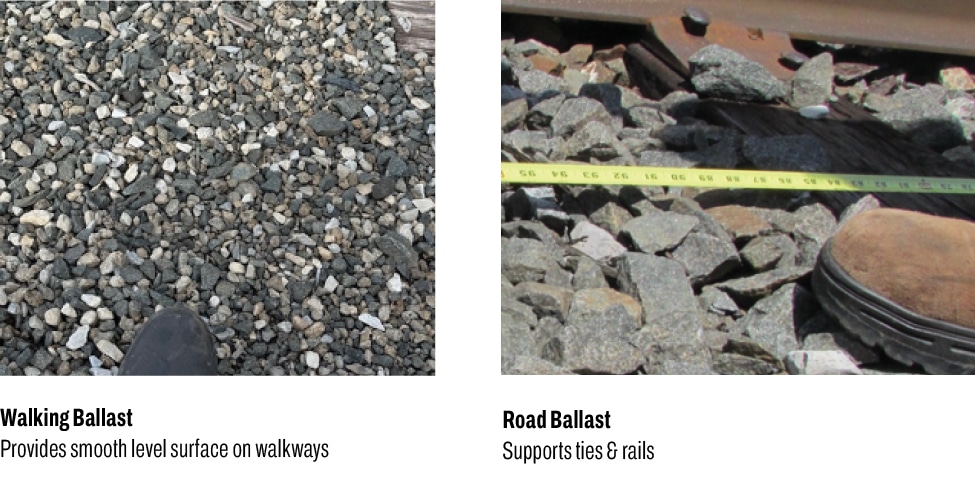
- Walking ballast (a smaller sized ballast) on walkways and along yard tracks;
- Employee walkways that cross tracks;
- Designated walkways on, or adjacent to, highway-rail grade crossings.
- Walkway Safety Standards: The TRIMS Policy shall also require that walkways and other areas where employees are required to work and walk shall be kept in a safe condition, free from slipping and tripping hazards, including debris, trash, tools, ice, snow, stored materials that obstruct the walkways and other walking hazards.
- Walkways along tracks and in rail yards, where employees regularly work and walk, must have a smooth, level surface, for example, asphalt, concrete, wood or walking ballast (bed of stones that makes up a track bed)*
- Inspections: The TRIMS Policy shall include track inspection standards that set forth regular periodic track inspections to monitor and ensure compliance with the aforementioned TRIMS Policy technical specifications.
- Regular periodic inspection intervals will be established for the in-plant railroad track and right-of-way that shall not be less than one inspection per month (with a minimum of 25 days between inspections).
- Inspections shall be performed by inspectors who have been trained and qualified on the requirements of the company’s TRIMS Policy. Inspectors must be trained, and qualified to inspect to:
- FRA standards, where applicable; and;
- Other track and right-of-way standards pertaining to issues not covered by FRA standards (e.g. standards of the General system servicing railroad, and/or AREMA standards that have been adopted by the company, pursuant to TRIMS Policy and walkway standards).
- Employee Training: Railroad employees and safety committee members shall be trained to recognize, and report defective conditions that fail to meet the standards set forth in the TRIMS Policy, and other right-of-way hazards, that have the potential to cause a train accident or employee injury.
- These defective conditions include, but are not limited to:
- Broken or cracked rails;
- Broken or gapped switch points;
- Track geometry deviations (E.g. Defects in profile, alignment, cross level and wide gage);
- Broken or missing switch and derail targets;
- Broken or missing switch and derail keepers;
- Switches that are hard to operate;
- Illegible or missing safety related signage, including close clearance, and no clearance signs, and/or markers;
- Obstructions placed on or near the track;
- Broken, malfunctioning or missing light fixtures;
- Vegetation that obstructs the view of railroad signals, and/or safety-related signage or otherwise interferes with employees performing normal trackside duties.
- When reports are received regarding defective conditions and other right-of-way hazards that have the potential to cause a train accident or employee injury, they shall be investigated immediately by the safety committee or a qualified person and repairs shall be made as soon as possible. Operating restrictions (e.g. speed restrictions) will be established, as necessary, to protect against accidents and/or injuries until repairs are completed and a stop work authority used as needed per company procedures.
- These defective conditions include, but are not limited to:
- Curve Speeds: All track curves shall be evaluated by a qualified track engineer or other qualified railroad track professional to determine the maximum safe train operating speed that shall be permitted.
- All curve operating speeds that are less than the in-plant railroad’s maximum authorized operating speed shall be published in the TRIMS Policy;
- All train crew employees will be trained on the location of each curve speed restriction and the authorized speed over the curve. They will also be issued with written copies of the curve speed restrictions.
- Roadway Worker Protections: All employees or contractors who perform track inspection and/or maintenance work (i.e. roadway workers) that requires fouling a track, shall be protected from train movements in the following manner:
- Watchman/Lookout: If the track work allows the roadway workers to be clear of the track at least 15 seconds prior to the arrival of a train, and the roadway workers are not using power tools or machinery, the in-plant railroad may assign a qualified employee to serve as a watchman/lookout.
- The watchman/lookout’s sole responsibility is to be in a position to watch for approaching trains and warn the roadway workers to clear off the track at least 15 seconds before the arrival of the train.
- The warning method or device must be easily seen or heard above ambient noise levels.
- Positive Track Protection: If the roadway workers cannot be clear of the tracks 15 seconds before the arrival of a train, or if they are using power tools or machinery, the switches providing entry into the track they are working on will be lined and locked to prevent on-track equipment from entering the track.
- Only the roadway workers, and their watchmen/lookouts, may lock and unlock the switches;
- A derail may be placed and locked on the track in lieu of lining a switch;
- Per FRA, a red flag or red cone will be placed in the gage of the track at the derails or switches that are used to provide roadway worker protection.
Railroad Policy – 3: Horizontal and Vertical Track Clearances Policy
- Clearances for railroad operations shall be classified as follows:
- Standard Clearance: At a minimum, six (6) feet horizontally from the outer edge of any rail and at a minimum twenty-two (22) feet vertically from the top of any rail.
- Additional clearance distances are needed on curves because the ends of railcars extend further from the tracks on the outside of a curve, and the middle of the railcar extends further from the tracks on the inside of a curve.
- Close Clearance: less than horizontal standard clearance, but is sufficient to allow safe passage of the railroad equipment.
- No Clearance: location where it is not safe for train or on-track equipment to pass due to insufficient clearance from:
- Equipment on adjacent track;
- Fixed structures adjacent to above the track, including building, fence, signage, poles, power lines, etc.
- Material stored or placed adjacent to track;
- Motor vehicles parked adjacent to track;
- Any other obstruction adjacent to track.
- Standard Clearance: At a minimum, six (6) feet horizontally from the outer edge of any rail and at a minimum twenty-two (22) feet vertically from the top of any rail.
Trains or other on-track equipment must not pass through no clearance areas.
- Restricted Vertical Clearance: vertical clearances less than the vertical standard clearance of 22 feet.
- Employees are only permitted to ride on the sides of on-track equipment when there is standard clearance on the side of the track where the employee is riding.
- Employees are prohibited from riding the side of on-track equipment into or through a close clearance area. When a close clearance area is encountered employees must:
- Stop movement, dismount equipment and walk through or past close clearance area before re-boarding equipment; or
- Stop movement and cross over to opposite side of equipment, if that side has standard clearance.
- Close Clearance and No Clearance Remediation: A risk assessment must be performed that identifies and evaluates all close clearance and no clearance areas, and have the hierarchy of controls applied. Close clearance and no clearance areas shall be eliminated or remediated, as follows;
- Permanent Close Clearances (e.g. due to fixed structures):
- Shall be eliminated where feasible. See USW Hazard Alert: Hazard-Alert_Fatal-Incident-Involving-an-In-Plant-Railroad-Conductor.pdf
- When elimination is not feasible, permanent close clearance areas shall be marked with warning signs: Close Clearance – Do Not Ride Past This Point.
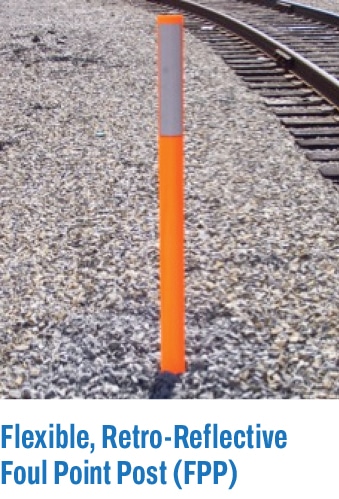
- Retroreflective Foul Point Posts (FPP) must also be used to mark permanent close clearances. FPPs must be flexible and capable of bending to the ground when stepped on so as not to create a tripping hazard.
- Where FPPs are used, their locations must be recorded on a track diagram and must be monitored during regular periodic track inspections.
FPPs that are damaged or missing must be replaced as soon as possible.

- Permanent No Clearances due to fixed structures (e.g. buildings, poles, etc.)
- Shall be eliminated by removal of the obstruction or removal of the track.
- No clearance areas that cannot be eliminated shall be protected by installation of a bumper block or track barricade placed across track and signage placed in advance stating: Stop – Track Out of Service. Where nighttime operations occur, warning lights must be installed.
- Temporary Close Clearances/No Clearances due to on-track equipment fouling adjacent tracks at switches/turnouts and/or adjacent tracks with insufficient track spacing.
- If a train stops near a switch for a train meet or to be left unattended, it shall stop at least one car-length clear of the switch points and the foul point for the adjacent track. [See: Safety Procedure – 16: Operating Track Switches]
- When a train stops near a switch to drop off a crew member to operate the switch, it should stop at least 25 feet from the switch points to avoid crowding the switch.
- Warnings shall be placed at locations where on-track equipment has the potential to create temporary close clearance and no clearance situations, including, at the foul points of track switches or turnouts, and on adjacent tracks where clearances between the tracks are tight.Warnings may include:
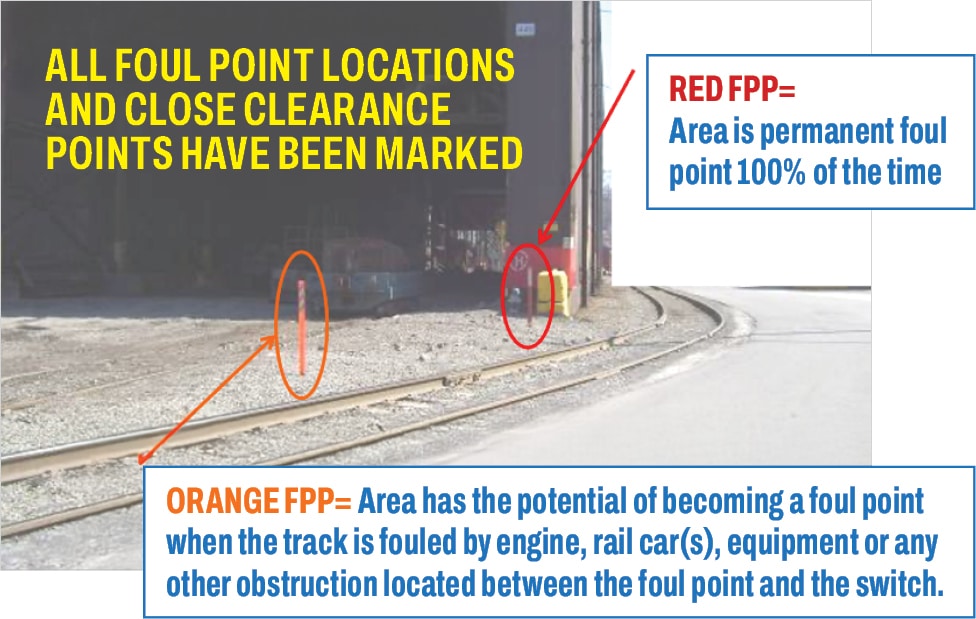
- Painted ties (yellow or a bright fluorescent color) or FPPs at least 10 feet outside the foul point of switch/turnout.
- FPPs in between adjacent tracks that mark temporary close clearances:– Must be flexible and bend to the ground when stepped on so as not to create a tripping hazard.– Must be a different color than FPPs used for permanent close clearances
- FPP locations must be recorded on a track diagram, and must be monitored during regular periodic track inspections.
- FPPs that are damaged or missing must be replaced as soon as possible.
- Below is an example of the placement of FPPs to mark permanent close clearances (red FPP) and temporary close clearances (orange FPP)
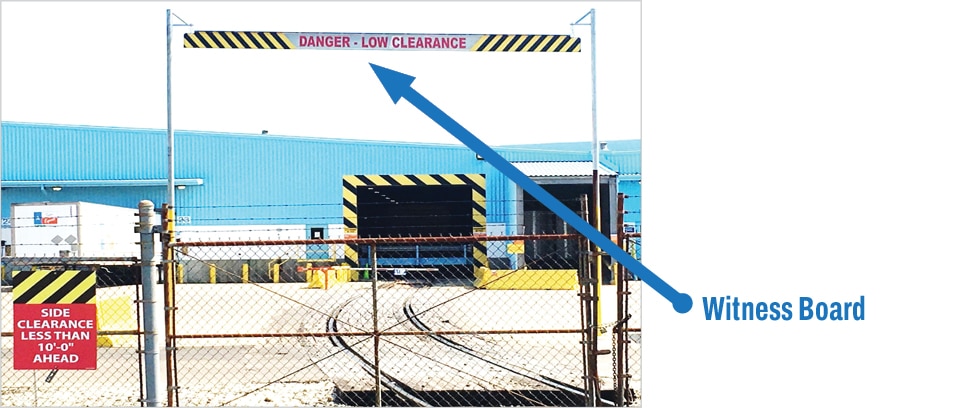
- Restricted Vertical Clearances: If any restricted vertical clearances exist over any in-plant railroad track, a high-car detector or witness board shall be installed to detect on-track equipment that exceeds the height of the restricted vertical clearance.

- The witness board or other safety warning devices shall be capable of warning train crews of any equipment in their train that exceeds the restricted vertical clearance. This warning may be provided by:
- An automated warning system (e.g. radio message, warning lights, etc.), or
- Having a train crew employee in a position to observe the train passing under the witness board or other safety waning devices, and having the capability to direct the train to come to a safe stop.
- The witness board shall be in a location that allows the train crew sufficient time to receive warning of the excessive height car and allow them to bring the train to a safe stop.
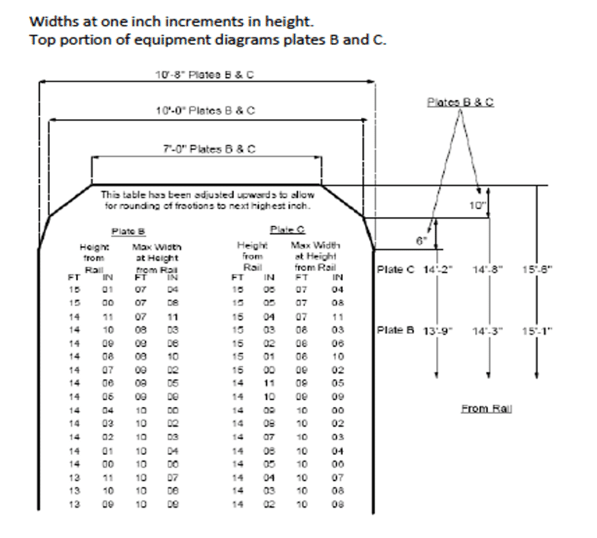
- Management officials must become familiar with the plate standards of the Association of American Railroads (AAR) which lists the dimensions of most railcars in North America. e.g. Plate B & C standards in the diagram below) There must be systems in place to monitor the dimensions of cars that are owned or leased or hired by the company, and operated on the in-plant railroad, to ensure they meet appropriate clearance standards as well as employee training and procedures.

Railroad Policy – 4: Highway Rail Grade Crossing
- Standards of Care: There are over 160,000 highway-rail grade crossings in the U.S. on public roadways, all of which are subject to Federal Railroad Administration (FRA) safety regulations. The motoring public is accustomed to and relies upon the safety provisions set forth in these regulations. While highway-rail grade crossings located on in-plant / in-mill railroads are typically not subject to these regulations, it is strongly recommended they comply with the standards of care embodied by these federal railroad safety requirements, to the extent feasible, to avoid confusion by the users of the crossings, and prevent fatalities and injuries.
- Sounding the Train Horn: Trains, with a locomotive in the lead, shall sound their horns approaching a highway-rail grade crossing beginning 15 seconds before entering the roadway. The horn sounding pattern should be two long sounds, followed by one short sound followed by one long sound. This horn pattern must be prolonged or repeated until the train enters the crossing.
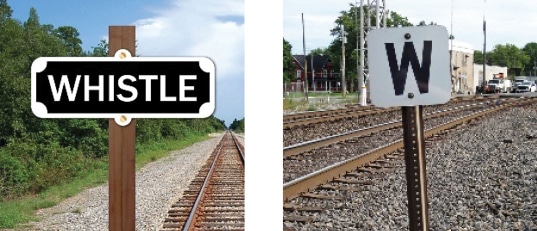
- Whistle posts shall be installed alongside tracks approaching railroad grade crossings at the location where the train horn sounding must begin.

- Whistle posts shall be installed alongside tracks approaching railroad grade crossings at the location where the train horn sounding must begin.
- Shoving Over a Crossing: If a train is shoving railcars over a highway-rail grade crossing that has no active warning devices (i.e. flashing lights or crossing gates) or is only equipped with flashing lights, a train crew employee or other qualified individual shall be on the ground to flag highway traffic. The train should be prepared to stop and not proceed over the crossing until directed to do so by the employee on the ground protecting the movement.
- If the crossing is equipped with crossing gates and the gates are seen to be operating properly (i.e. all gates are down and warning lights are flashing), the train may proceed over the crossing without stopping.
- Employees shall not ride the outside of any railcar while travelling over a highway-rail grade crossing unless equipped with flashing lights and crossing gates in the down position.
- Employees shall not ride on the steps of a locomotive while travelling over a highway-rail grade crossing.
- Flat cars can be difficult to see when shoved over a highway-rail grade crossing at night. When flat cars are being shoved over a public grade crossing at night, additional warning measures must be considered, including placement of flares or orange cones across the roadway.
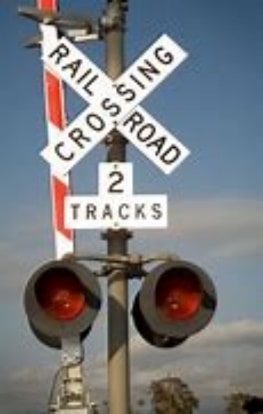
- Signage: Railroad crossing signs shall be installed at roadway/pathway approaches to all in-plant highway-rail grade crossings and pedestrian crossings to alert crossing users to the presence of the crossing.
- The preferred signage is a crossbuck sign that conforms to Section 8B.03 or 8B.04 of the Manual on Uniform Traffic Control Devices (MUTCD).
- Other generally recognized railroad crossing signage may be used, if determined by an engineering study.
- Once installed, signage shall be periodically inspected and maintained during regular track inspections. Vegetation and obstructions shall be controlled to ensure a clear line of sight
to signage and crossing signals.

- Pavement Markings: Highway-rail grade crossings over paved roadways shall have stop lines painted on the pavement indicating where vehicles are required to stop. Preferably, placement of the stop lines shall correspond to Section 8B.27 or 8B.28 of the MUTCD, unless an engineering study determines otherwise.
- Active Warning Devices (Flashing Light Signals and Crossing Gates): If crossings are equipped with active warning devices, these devices must be maintained and inspected in accordance with FRA standards embodied in 49 CFR Part 234 Grade Crossing Safety and the crossing equipment manufacturer’s instructions.
- Only trained and qualified crossing signal maintenance personnel should be allowed to inspect, maintain and repair railroad grade crossing signal systems.
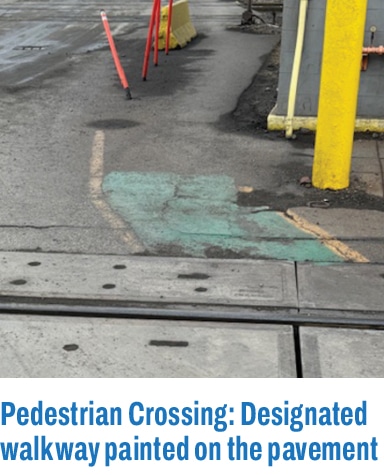
Pedestrian Crossings: Where pedestrians are permitted to cross the tracks at a highway-rail grade crossing, a designated pedestrian walkway shall be painted along the edge of the roadway in yellow or a high visibility color to identify the pedestrian walkway.

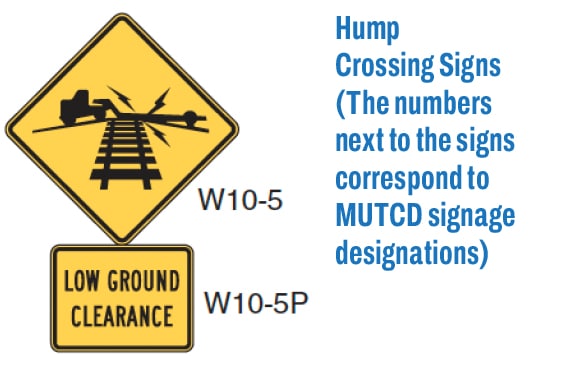
- Hump Crossings: Hump crossings pose a hazard to trucks and trailers with low ground clearance that can cause them to hang up on the track. Hump crossings must be engineered out, where feasible. Hump crossing warning signs must be installed that conform to the MUTCD. Company policy must prohibit use of hump crossings by trucks, trailers and other motorized vehicles that have the potential to become stuck on the hump crossing.

- Procedures for Crossing Use: The company shall publish procedures regarding the safe use of highway-rail grade crossings and pedestrian railroad crossing/pathways.
- All plant personnel and contractors shall be trained on the Company’s requirements for the safe use of crossings.
- The union-management safety committee shall conduct periodic safety audits to ensure compliance with the company’s procedures for the safe use of railroad crossings.
Railroad Policy – 5: Remote Control Locomotive
- Each in-plant railroad that utilizes one or more Remote-Control Locomotives (RCL) in its operations shall adopt and implement RCL safety standards that are in accordance with the following RCL safety specifications and procedures.
- Only employees who have been trained and qualified on the in-plant railroad’s safety standards may operate a RCL or work with an RCL train crew.Note the following terminology:
RCL: Remote-Control Locomotive – a locomotive equipped to be operated remotely (without an operator in the locomotive cab who is directly using the locomotive controls)
RCO: Remote-Control Operator – personnel who are trained and qualified to operate an RCL
OCU: Operator-Control Unit – the device or box used by the RCO to operate the RCL - RCL System Safety Design and Operational Requirements
- Each OCU must, at a minimum, have the following features:
- directional control;
- graduated throttle or speed control;
- graduated locomotive independent brake application and release;
- train brake application and release control;
- audible warning device control (horn);
- audible bell control, if equipped;
- sand control (unless automatic);
- headlight control;
- emergency air brake application switch;
- generator field switch or equivalent to eliminate tractive effort to the locomotive; and
- audio or visual indication of wheel slip/slide.
- Although an OCU can have the capability to control different RCLs at different times, it must be designed to be capable of controlling only one RCL or one RCL train at a time.
- An OCU having the capability to control more than one RCL must have a means to lock in one RCL “assignment address” to prevent simultaneous control over more than one RCL.
- RCL must respond only to the OCUs assigned to that receiver.
- The OCU must be designed to require at least two separate actions by the RCO:
- before RCL movement can begin (in order to prevent accidental movement)
- before changing speeds
- before applying or changing brake applications.
- When an OCU’s signal to the RCL is interrupted for a set period, not to exceed five seconds, the remote-control system must cause:
- full service application of the locomotive and train brakes; and
- elimination of locomotive tractive effort.
- If an OCU is equipped with an “on” and “off” switch, the switch, when moved from “on” to “off” position, must result in:
- application of the locomotive and train brakes; and
- elimination of locomotive tractive effort.
- Each RCL must have a distinct and unambiguous audible or visual warning device that indicates to nearby personnel that the locomotive is under active remote control and subject to movement.
- Each OCU must be equipped with an operator alertness device requiring manual resetting or its equivalent. It must incorporate a timing sequence not to exceed 60 seconds. Failure to reset the switch within the timing sequence must result in:
- application of the locomotive and train brakes; and
- elimination of locomotive tractive effort.
- Each OCU must have a “tilt feature” that, when tilted to a predetermined angle, must result in:
- an emergency application of the locomotive and train brakes; and
- elimination of locomotive tractive effort.
- If the OCU is equipped with a “tilt bypass” system enabling the tilt protection feature to be temporarily disabled, the bypass feature must deactivate after 15 seconds, unless reactivated by the RCO.
- The RCL must be equipped with a device that causes an application of the locomotive and train brakes and elimination of locomotive tractive effort whenever the RCL’s main reservoir air pressure falls below 90 psi or when a locomotive protection alarm is activated while the locomotive is in remote operation. The device must need to be manually reset on board the RCL.
- When the air valves and the electrical selector switch on the RCR are moved from manual to remote or from remote to manual modes, an emergency application of the locomotive and train brakes must be initiated to prevent unauthorized use of the system.
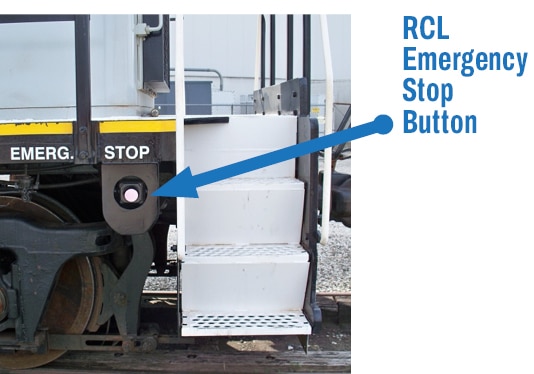
- Each RCL must be equipped with four (4) emergency stop buttons, (two on each side of the RCL, on the front and back ends) which shall be clearly marked. The buttons shall be located to allow easy access to ground personnel to activate the button to initiate an emergency stop of the RCL. When an emergency stop button is pressed, it mustresult in:
- an emergency application of the locomotive and train brakes; and
elimination of locomotive tractive effort.

- Each RCO shall be provided with OCU vests onto which the OCU must be secured. OCU vests must be designed with the following features:
- High-visibility material with retroreflective strips, patches and/or markings.
- Several sets of clips that allow securement of the OCU in a position most comfortable and ergonomically sound for the individual RCO
- A “breakaway” safety feature designed to easily break free of the RCO in the event the vest or OCU becomes entangled on equipment
- The OCU vest must be designed to direct the weight of the OCU onto the RCO’s shoulders
- Site specific hazards must be considered when selecting an appropriate OCU vest. For example, if the RCO is required to wear flame-retardant and/or chemical-retardant protective clothing, the OCU vest must also be flame -retardant and/or chemical-retardant.
- Each OCU must, at a minimum, have the following features:
- Operating Practices
The railroad must establish written standard operating procedures tailored to its RCL operations. RCOs must be trained and qualified on these procedures before being allowed to operate an RCL. At a minimum, these procedures must include the following:
- Procedures shall be established for putting the RCL into remote-operating mode and into manual-operating mode.
- Upon going off duty, each RCO must place the RCL in manual operation and properly secure it, unless control of the RCL is directly given to a relieving RCO.
- When operating a RCL, the RCO must not:
- ride on a freight car under any circumstances;
- ride on the bottom step of the RCL;
- mount or dismount moving equipment;
- operate any other type of machinery; or
- stand or walk within the gage of the track or foul the track on which the movement is occurring, while physically located in front of the movement.
- RCOs must ensure that the track is clear and properly aligned ahead of the remotely controlled movement while it is underway. Therefore, RCL operations must be operated at restricted speed not to exceed 20 mph, i.e., at a speed that will enable stopping the movement within half the range of vision assuring that all movements are protected.
- The RCO must operate only one RCL at a time.
- In-plant railroad management must adopt procedures for 3-Step Protection (Red Zone Protection) to protect personnel who must go on, under or between equipment as part of an RCL train.
- Security
- Management must develop and implement procedures for the proper storing and handling of OCUs when not in use or in the operator’s possession.
- The operation control handles located in the RCL cab must be removed or pinned in place to prevent accidental or intentional movement while the RCL is being operated in remote.
- The railroad must have strict procedures in place to ensure that only the intended OCUs are assigned to the appropriate RCL.
- Inspections and Tests
- The RCL system must be included as part of the daily locomotive inspection, because this equipment becomes an appurtenance to the locomotive.
- Each time an OCU is used for the first time on each shift, a test of the air brakes and the OCU’s safety features (e.g. tilt switch, alerter device, horn, bell, etc.) must be conducted.
- The RCL system (both the OCU and RCR), must be designed to perform a self-diagnostic test of the electronic components of the system. The system must be designed to immediately “fail safe” (full service application of the locomotive and train brakes and the elimination of locomotive tractive effort) in the event a failure is detected.
- The RCL system components that interface with the mechanical devices of the locomotive, e.g., air pressure monitoring devices, pressure switches, speed sensors, etc., must be inspected and calibrated as often as necessary, but not less than the locomotive’s periodic inspection interval. The company must maintain records of such inspections and tests.
- OCU vests must be inspected daily. Vests found with tears, broken clips, exposed or protruding metal or plastic slats, or other defects, must be immediately removed from service and replaced.
- Notification of RCL Use and Protection of Workers
- Each RCL must have a tag placed on the control stand throttle indicating the locomotive is being used in a remote-control mode. The tag must be removed when the locomotive is placed back in manual mode.
- In areas where RCL operations are being conducted, warning signs must be posted indicating that there is no operator in the control compartment of the locomotive. These warning signs must be highly visible and posted at conspicuous locations so as to maximize their exposure to those most likely to encounter RCL operations.
- When Blue Signal Protection is required (See: Safety Procedure – 11: Blue Signal and Flag Protection), the locomotive must be placed into manual mode, and be properly secured. The appropriate blue signal protection must then be provided.
- Designated at-grade roadway crossings and pedestrian crossings, located in RCL territory, shall be equipped with highly visible warning signs that indicate the locomotive is unoccupied.
Examples:“Remote-Control Locomotives Operations: No Personnel in Locomotive” or“Remote-Control Locomotive Operations: Locomotive is Unoccupied”
Railroad Policy – 6: Trackmobile
- Each in-plant/in-mill railroad that utilizes one or more Trackmobiles in its operations shall adopt and implement Trackmobile safety standards that are in accordance with the following Trackmobile safety specifications and procedures.
- Only employees who have been trained and qualified on the in-plant railroad’s safety standards may operate a Trackmobile or work with a Trackmobile train crew.
- The company shall develop and issue operating procedures for moving railcars that, at a minimum, include the following:
- Daily Trackmobile safety inspection procedures;
- Car/tonnage limits for operating with and/or without the use of the train airbrakes (automatic brakes);
- Safe operating speeds that consider the grade and curvature of the in-plant railroad’s trackage;
- Trackmobile and train securement procedures to provide 3-Step Protection (Red Zone – see: Safety Procedure – 4) to protect crew members when working on, under or between on-track equipment;
- Trackmobile and train securement procedures for leaving trains unattended;
- Proper use of all safety Trackmobile safety devices e.g. audible warnings (horn and bell), headlights, sanders, etc.
- The Trackmobile must be equipped with a hands-free radio or radio headset that allows for hands-free radio operation while operating the Trackmobile;
- The company’s Trackmobile safety procedures shall meet or exceed applicable manufacturer recommendations.
- The company must develop and implement a written Trackmobile training plan for Trackmobile operators, train crews and maintenance personnel with Trackmobile maintenance responsibilities, that includes the following:
- Initial training requirements and a training curriculum to qualify Trackmobile operators, train crews and relevant maintenance personnel on all required operating procedures and safety requirements;
- Trackmobile inspection requirements for Trackmobile operators, train crews and relevant maintenance personnel;
- A schedule for regular periodic Trackmobile refresher training;
- Optional refresher training for previously trained and qualified Trackmobile operators and train crew employees who have been away from Trackmobile operations for a predetermined amount of time;
- Trackmobile training requirements and curriculum must be reviewed periodically and no less than annually;
- Establish procedures and schedules for Trackmobile safety inspections/audits that include the following:
- Monthly safety inspections/audits of Trackmobile operations;
- Periodic safety inspections/audits of Trackmobile training;
- Tracking of safety inspections/audits findings and action plan to resolve/address captured items